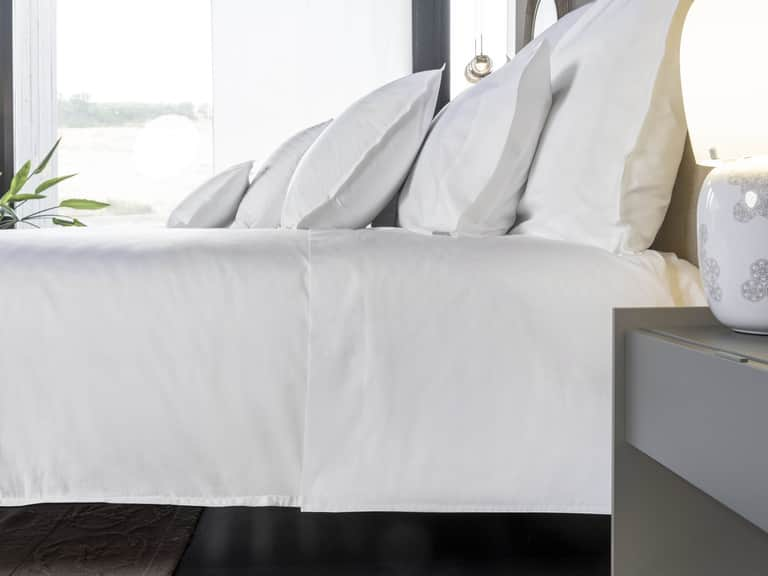
Textile Heritage · Bedding
From Flax Field to Bedroom: Tracing Naturepedic’s Organic Bedding
A linen sheet begins as a plant in a field, but it reaches the bedroom through a sequence of choices: where the flax grows, how its stalks are processed, how the fibers are spun and woven, and what happens to the cloth before it is made into bedding. Following that route offers a way to see a familiar household object as both a material and a small piece of textile history.
A plant with a long textile memory
Flax has a talent for seeming ordinary. Its slender stems and blue flowers are easy to pass without imagining the sheets folded in a cupboard, the table linen laid for a meal, or the old cloth preserved in a museum case. Yet linen—the fabric made from flax—belongs to one of humanity’s oldest textile traditions. The plant has supplied fiber, seed, and oil; its stalks have been turned into cloth through labor and knowledge accumulated across generations.
That long history is not a single uninterrupted story, nor does every linen fabric follow precisely the same route. Regions, tools, markets, and methods have changed. Still, the basic transformation remains strikingly legible: a crop is harvested, its useful fibers are separated from the rest of the plant, those fibers are prepared and spun, and the resulting yarn is woven into cloth. A bed sheet is the calm end of a process that begins in soil and weather.
For Naturepedic’s organic linen bedding, the stated material journey begins with flax grown in France. The company’s product information describes its organic linen sheets and duvet covers as made from certified organic flax, with the linen fabric woven in India at a GOTS-certified facility. Those details describe particular products, not every linen item or every stage of the industry. They nonetheless make a useful starting point for understanding how place, fiber, and manufacture come together.
The field: where the fiber begins
Flax is an annual crop, and its usefulness depends in part on what the grower intends to harvest. Flax grown for fiber is generally cultivated for its long stems; flax grown primarily for seed is selected and managed for a different purpose. The distinction matters because textile linen depends on the quality and length of the fibers within the stalk. A field is not simply a scenic prelude to fabric. It is the first workshop.
Growing conditions shape the crop, though they do not by themselves determine the finished cloth. Soil, rainfall, temperature, cultivation practices, and timing influence how flax develops. In many flax-growing areas of Europe, the climate and agricultural knowledge have supported a substantial history of fiber production. France remains an important source of flax fiber, and the French origin named for Naturepedic’s bedding connects the product to that agricultural landscape.
The word “organic” adds another layer, but it should be read with care. In a textile context, a certification such as the Global Organic Textile Standard (GOTS) concerns specified requirements across relevant stages of processing and supply, subject to the scope of the certification. It is not a poetic synonym for natural, nor does it mean that every environmental question has been answered. Certification provides a framework and a set of claims that can be checked; readers interested in a specific item should consult its current product documentation for the precise scope and status.
There is also a difference between knowing where a crop was grown and knowing everything about its cultivation. A stated country of origin gives useful geographic context, but it does not, on its own, describe a particular farm, the seasonal conditions, or each agricultural decision. Responsible textile storytelling can acknowledge the value of provenance without turning a location into a complete account of production.
From stalk to spinnable fiber
Once flax is ready for harvest, the textile work begins in earnest. Fiber flax is commonly pulled rather than cut, a method that can preserve the length of the stalk fibers. The harvested plants are then dried and processed. One traditional stage, known as retting, uses moisture and time to loosen the bonds between the useful fibers and the surrounding tissues of the stem. Depending on the method and conditions, retting may take place in the field or through controlled processing.
After retting, the dried stems are broken and scutched: woody material is crushed and removed, leaving bundles of fiber. The fibers are then combed or otherwise prepared to align them for spinning. These operations sound mechanical, but their results are tactile. Fiber length, cleanliness, alignment, and the handling of the material all affect how it can be spun and how the yarn behaves later.
It is tempting to picture this sequence as a neat march from plant to fabric. In reality, the work is full of judgment. Processing must remove unwanted material without needlessly damaging the fibers. A small difference in preparation can influence yarn consistency, and yarn consistency can influence the texture and strength of the cloth. The process is practical, but it has the accumulated intelligence of craft.
These stages also help explain why the phrase “linen fabric” conceals so much. A piece of cloth is not simply the flax plant made flat. It is the outcome of choices about harvest, preparation, spinning, yarn construction, weaving, and finishing. Two fabrics made from flax may differ in weight, surface, drape, and hand even when both are accurately called linen.
Spinning: giving the fibers direction
Spinning turns prepared flax fibers into yarn. The fibers are drawn out and twisted so that they hold together as a continuous thread. Linen yarn can be made in different ways, and the choice affects its character. The staple length and preparation of the fibers, the degree of twist, and the intended fabric all play a part. Fine yarn may support a lighter cloth; a different yarn structure may be suited to a more substantial weave.
Flax fibers have a reputation for strength, but strength is only one part of their appeal. Linen is often valued for its cool, dry feel, its capacity to absorb moisture, and the distinctive way it softens with use and laundering. These qualities are not a guarantee of a particular experience: fabric weight, weave, finishing, room temperature, and personal preference all matter. A fiber can have characteristic tendencies without behaving identically in every textile.
Yarn is where the plant’s individuality begins to meet the discipline of manufacture. It has to be consistent enough to weave, but the final cloth need not conceal every irregularity. Linen’s subtle variations—the small differences in texture that lend it a particular visual grain—are part of what many people find appealing. The aim is not always a surface that looks machine-perfect. Often it is a fabric whose order still leaves room for the material to be seen.
The loom and the character of cloth
Weaving interlaces lengthwise and crosswise yarns to create a stable surface. The basic structure may be familiar, but the possibilities are extensive. The spacing and tension of the yarns, the weave structure, and the fabric’s weight influence how the cloth falls and feels. A tighter or looser construction can change the surface and airflow; the yarn itself, along with finishing, contributes to softness and drape.
Naturepedic describes its organic linen bedding as woven in India from flax grown in France. The geographical distance between field and loom is not unusual in a global textile supply chain, where different regions may specialize in cultivation, spinning, weaving, or finishing. It is also a reminder that “origin” can refer to more than one place. The crop’s origin and the fabric’s manufacturing location are different facts, each illuminating a different part of the object’s journey.
For readers, that distinction is more than a technical footnote. A country named beside a fiber tells us where the plant was grown; a country named beside a finished textile may identify where it was woven or made. Neither statement necessarily accounts for every intermediate stage. Clear product descriptions help prevent these meanings from collapsing into one vague claim of “heritage” or “craftsmanship.”
The loom also marks a transition from material history to domestic life. Once flax has become cloth, it can be cut and sewn into a sheet or duvet cover. The fabric’s weight and texture become immediate: a hand encounters the weave rather than the crop. Yet the field has not disappeared. It is present in the fibers, just as the decisions made during processing remain present in the way the linen drapes, wrinkles, and wears.
Finishing: the last transformations
Woven cloth is not necessarily ready to become bedding. Finishing can include washing, softening, dyeing, or other treatments that refine the surface and prepare the fabric for use. The exact sequence varies by product. Naturepedic describes its linen bedding as stone-washed, a process intended to give the material a softer, more relaxed feel. Such a finish can influence the fabric’s first impression, while repeated washing contributes to how linen changes over time.
Finishing is sometimes treated as decoration, but it is part of the textile’s identity. A fabric’s hand—the way it feels when touched—does not come from fiber alone. It reflects the combined effects of yarn, weave, finishing, and use. A newly finished sheet may feel different from one that has been laundered many times. That change is not automatically deterioration. For linen, softening with use is often understood as part of its appeal, though durability still depends on construction and care.
Colour introduces its own questions. A neutral shade may appear quiet, but achieving and maintaining colour involves material and process choices. Product descriptions may identify available colours without explaining every detail of dyeing, so it is wise not to infer more than the label states. Transparent information is most useful when it distinguishes what is certified, what is known about origin, and what remains unspecified.
A sheet is also a piece of construction
When cloth becomes bedding, the qualities of the textile meet the ordinary demands of a bed. Sheets must fit a mattress, withstand turning and laundering, and be comfortable against the skin. Naturepedic’s organic linen sheet set is described as including a flat sheet, a fitted sheet, and two pillowcases. The fitted sheet has a 15-inch pocket, while the duvet cover sets include a cover and two pillow shams, with corner ties intended to keep an insert in place.
These details may seem mundane beside the romance of a flax field, but they are where design becomes useful. A secure fit, well-finished seams, and a closure that functions easily can shape a textile’s everyday life as surely as its fiber content does. Bed linen is handled repeatedly. Its construction is tested not in a gallery but in routines: changing sheets, making a bed, washing, drying, folding, and beginning again.
The bedding is described as made from 185-gram-per-square-metre organic linen, with the flax grown in France and the fabric made in India in a GOTS-certified organic facility. That specification offers a more concrete picture than the broad adjective “luxury.” The weight signals something about the fabric’s substance, while the fiber and origin statements identify parts of its material route. None of these facts alone determines whether a particular sleeper will like the feel; together, they make the product easier to understand.
Claims about comfort should be held in proportion. Linen is often chosen for its breathability and moisture handling, and its texture can feel cool to some people. But comfort is personal and depends on more than fiber. A sleeper’s preferred warmth, the climate, the mattress, the room, and the fabric’s finish all contribute. A textile’s reputation is a useful guide, not a substitute for lived experience.
Care as a continuation of the story
Care instructions are a form of material knowledge. Naturepedic’s cited care guidance for its organic linen sheets and duvet covers is machine washing warm, tumble drying on low, warm ironing if desired, and avoiding bleach. Following the directions provided with the particular item is important, since construction and finishing can vary between products and may change over time.
In general, gentle, appropriate laundering helps limit unnecessary stress on fibers. Overloading a machine can prevent textiles from moving and rinsing freely; excessive heat can place more strain on fabric than a lower setting. Detergent residues may build up if too much is used. These observations are not peculiar to linen, but they matter for any bedding expected to last through repeated cycles of use.
Ironing is a matter of preference. Linen wrinkles readily, a consequence of the fiber’s structure and the way it responds to bending. Some people enjoy a pressed, orderly appearance; others prefer the relaxed surface that comes with ordinary use. Neither approach is a moral position. The fabric does not need to be made to impersonate another fiber in order to be considered well cared for.
Storage has a quiet role, too. Clean, fully dry bedding kept in a dry, ventilated place is less likely to acquire unwanted odours or moisture-related problems. Rotating sets can distribute wear. Small repairs, made early, may prevent minor damage from becoming a larger tear. These acts are not grand gestures of sustainability, but they can extend the useful life of the things already in a home.
Organic claims and the value of precise language
Interest in organic bedding often begins with a reasonable question: what, exactly, does the claim mean? In this case, the product information identifies organic flax and GOTS certification for the relevant bedding and manufacturing facility. Certification can be a meaningful tool for understanding standards and accountability, but no single label is a complete life-cycle assessment. It does not automatically settle questions about transport, energy, water, labour conditions at every stage, or the comparative impacts of different materials.
Precise language helps readers make distinctions. “Flax grown in France” is a statement about agricultural origin. “Woven in India” identifies a manufacturing stage. “GOTS-certified” points to a certification framework, whose applicability should be checked against current documentation. “Linen” names the textile made from flax fibers. These descriptions work best together, without being stretched into claims they do not make.
There is a similar discipline in speaking about sustainability. Flax is a plant-based fiber, and growing it as a crop connects textile production to agriculture in a direct way. But the environmental performance of a finished article depends on numerous factors: cultivation, processing, dyeing and finishing, transport, product lifespan, and care. A thoughtful account can appreciate renewable plant fiber while avoiding the easy conclusion that “natural” automatically means impact-free.
The heritage inside an everyday object
There is something almost comically modest about the endpoint of this journey. After growing, harvesting, retting, breaking, scutching, combing, spinning, weaving, finishing, cutting, and sewing, the fabric is placed on a mattress. It is pulled smooth, or left loose. It is slept on, washed, folded, and used again. The long chain of work disappears into a domestic ritual so familiar that it can seem not to be a chain at all.
Following the flax back toward the field restores some of that scale. It helps explain why linen has carried cultural significance for centuries: not because every piece is precious, but because the material links land, skill, trade, and daily life. The same fiber can serve practical purposes and hold aesthetic meaning. A seam, a hem, or the irregular grain of a weave may be an understated record of decisions made far from the bedroom.
Naturepedic’s route—from French-grown flax to linen woven in India and made into sheets and duvet covers—offers one contemporary example of that relationship. It is specific enough to be followed, yet it does not represent every linen tradition. Its interest lies partly in the way it makes a modern supply chain visible: geography is distributed, craftsmanship occurs at several stages, and the finished bedding carries traces of both agriculture and manufacture.
To look closely at linen is to discover that “fine” need not mean glossy or immaculate. It can mean considered: a fiber selected for its qualities, processed into yarn, woven into a usable cloth, and cared for with an understanding of what it is. The sheet on the bed remains a sheet. But for a moment, it is also a field, a loom, a set of choices, and a very old human practice made newly ordinary.
A short guide to the journey
- Flax cultivation: the crop is grown for its textile fibers; Naturepedic identifies France as the origin of the flax used in its organic linen bedding.
- Fiber preparation: harvested stalks are processed to separate and align the useful fibers.
- Spinning and weaving: prepared fibers become yarn, which is woven into linen cloth; the cited Naturepedic fabric is woven in India.
- Finishing and sewing: washing and other finishing choices influence the cloth’s hand before it is cut and made into bedding.
- Use and care: laundering and everyday handling continue to shape the textile, helping determine how it feels and wears over time.
Product origins, specifications, certifications, and care guidance can change. Consult current product documentation for the details that apply to a particular item.

