Textile culture · The art of the table
The Quiet Art of Sferra Table Napkins: Hemstitch, Embroidery, and the Art of the Table
A napkin is a modest square with an unusually long memory. In its weave and its edges, the everyday business of dining meets the patient work of textile craft.
At a set table, the eye tends to make its first decisions quickly. It notices the plates, perhaps the flowers, the candlelight, the arrangement of glasses. The napkin, folded or simply laid beside a plate, may seem to have arrived without ceremony. Yet it is one of the table’s most intimate objects: picked up, unfolded, used, folded again. It passes through the meal in a way that a vase does not. Its smallness is part of its importance.
Fine table napkins bring together two kinds of attention. The first is practical: a cloth should feel pleasant in the hand, absorb a spill, wash well, and return to the table without losing its shape. The second is visual. A hem, a drawn-thread border, or an embroidered line can make a piece of fabric feel considered without asking it to become the center of the occasion. In that balance—utility on one side, refinement on the other—lies much of the quiet art of table linen.
Sferra table napkins offer a useful lens through which to consider this language of detail. Hemstitching and embroidery are not merely decorative flourishes. They are forms of construction, evidence of decisions made at the edge of a textile, where the fabric is most vulnerable to fraying and where finishing becomes visible. To look closely is to see a napkin not as an accessory but as the result of weaving, sewing, and a long inheritance of domestic craft.
The edge is where the story begins
Cloth is made of crossings: lengthwise threads, called the warp, meet crosswise threads, called the weft. Their arrangement produces the fabric’s structure, weight, and surface. A plain weave, for instance, has a simple over-and-under rhythm. Other weaves can create more elaborate textures or a different drape. But whatever happens in the body of the cloth, the edges have their own problem to solve. Cut threads can unravel. A hem turns and secures them; stitching holds that fold in place.
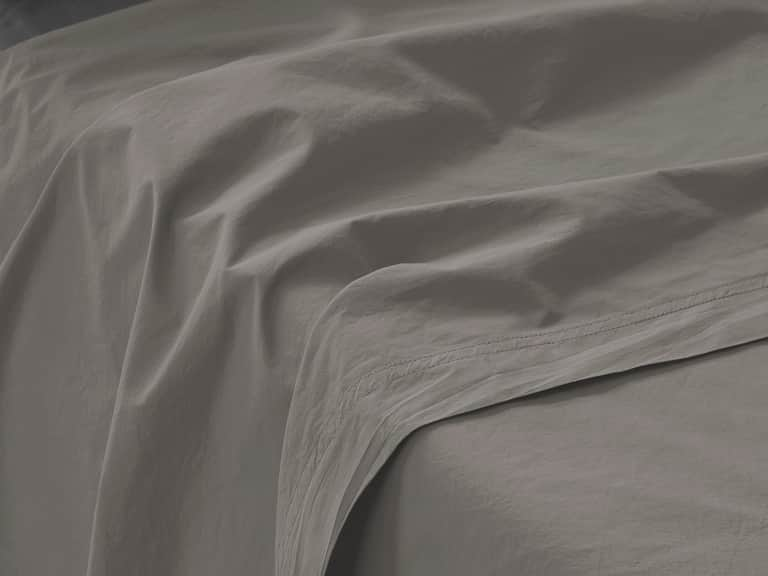
On a serviceable napkin, this finishing might be nearly invisible. On a more formal one, it may be a defining feature. A hemstitch border turns the boundary into a kind of drawn line: neat, measured, and restrained. Its effect is less like a frame around a picture than a pause at the edge of a sentence. The border says that someone has thought about where the cloth ends.
This is one reason table textiles can feel so expressive while remaining quiet. The design need not announce itself across the whole surface. A narrow band of stitching, visible only when the napkin is lifted or unfolded, can offer enough distinction. In a room of patterned china and polished silver, restraint is not an absence of design. It is a decision about proportion.
Napkin construction is also a small lesson in the relationship between beauty and durability. A finish must look orderly, but it has to withstand handling and laundering, too. A beautifully made edge that cannot bear ordinary use would be a kind of failure. The most successful details tend to be those that do their practical work without seeming to labor at it.
What hemstitching makes visible
Hemstitching is associated with a delicate, openwork appearance. In a traditional drawn-thread approach, some threads are removed from the fabric near the edge, and the remaining threads are grouped or bound with stitching. The resulting pattern can look airy and intricate, a fine ladder or a row of small openings. The particulars vary by technique and cloth, so the name is best understood as a family of finishes rather than one universal recipe.
That open structure gives hemstitching its characteristic tension. The fabric is still firmly finished, but the edge appears to breathe. Light finds the spaces between threads; the border registers as detail without adding a heavy band of color or texture. It can be formal, especially on a white or pale napkin, but it is not necessarily grand. Often its elegance comes from scale: a small, disciplined intervention that rewards a second look.
There is an old appeal in this kind of workmanship. Drawn-thread work belongs to a wider history of hand finishing and household needlework, in which useful cloth could also display skill. Decorative borders on linens have appeared in many places and periods, though their methods and meanings differ. It would be a mistake to treat every openwork edge as an unchanged survival from a single tradition. Still, the continuing attraction is easy to understand. A border that exposes the structure of the cloth makes the making itself part of the design.
On the table, hemstitch can provide a quiet boundary between napkin and setting. It may echo the linear geometry of a plate rim or soften the crispness of a pressed tablecloth. Folded into a rectangle, it can become a fine stripe. Opened across a lap, it reveals the full perimeter. The same detail changes its character according to how much of it is seen—and according to the company it keeps.
Embroidery, and the art of knowing when to stop
Embroidery takes a different route. Instead of opening or grouping the fabric’s threads to define an edge, it adds stitched marks to the surface. Those marks might form a monogram, a small motif, a border, or a line that appears almost incidental. Depending on its scale and placement, embroidery can be ceremonial, personal, or simply decorative.
The form asks an interesting question: how much can a napkin say without speaking over the meal? A small embroidered detail may lend a set of linens a sense of occasion. A monogram can suggest domestic history, though it need not be read as a grand declaration; it can also be a practical mark of ownership. A repeating border establishes rhythm. A lone motif makes the cloth feel individual. In each case, the placement matters as much as the pattern.
Good embroidery respects the cloth beneath it. Stitching that is too dense or too heavy can alter the way a lightweight fabric drapes. A carefully chosen detail, by contrast, works with the napkin’s surface and edge. It allows the textile to remain a textile: flexible, absorbent, and made to be handled. This is the difference between ornament that joins a design and ornament that sits on top of it.
Hemstitch and embroidery can coexist, but they create different kinds of attention. Hemstitch draws the eye outward, toward the perimeter. Embroidery asks it to pause at a particular point or follow a line. One is often structural as well as decorative; the other is more explicitly an addition to the surface. Neither is inherently more refined. Their success depends on how they relate to the fabric, the scale of the napkin, and the mood of the table.
The napkin as a participant in dining
Table-setting customs are not fixed laws. They shift across households, countries, and occasions. A napkin may be folded into a formal arrangement, laid simply beside a plate, or placed on the plate itself. At a relaxed supper, the cloth might be casually folded and passed around. At a more ceremonious meal, it may be treated as part of a larger composition. The important thing is not to confuse formality with a single correct arrangement.
The napkin is unusual among table linens because its use is so direct. A tablecloth makes a field; a runner creates a path; placemats mark separate territories. A napkin moves between the table and the person seated at it. Its scale is intimate, and its handling supplies a kind of choreography: it is lifted, opened, placed, and eventually gathered again. A stitched edge becomes part of that movement, sometimes visible in a fold, sometimes disappearing against the guest’s clothing.
For a composed setting, repetition can be more effective than abundance. Napkins with a restrained hemstitch border can lend continuity to a table without competing with patterned dishes. Embroidered details may provide a point of emphasis among plain plates and glass. A table with varied colors and textures might benefit from an undecorated cloth, whose simplicity gives the rest of the arrangement room to breathe. There is no universal formula. The useful question is whether the textiles appear to belong to the same conversation.
That conversation can be formal or easygoing. Fine linen does not require a special dinner to justify itself, and a beautifully finished napkin is not obliged to wait for a holiday. In daily use, it may become softer, more familiar, and more closely associated with the routines of a household. The evidence of use—handled folds, a slight softness at the edge—is not necessarily a defect. Cloth is made to enter life, not simply to remain untouched in a drawer.
A material made for touch
When people speak of linen, they usually mean cloth made from flax fiber. Its character depends on more than the plant itself: spinning, weaving, finishing, and laundering all have a part in the result. Linen can feel crisp or supple, smooth or visibly textured. It often has a natural irregularity that makes a flat surface less mechanically uniform than a sheet of paper. Those variations are not automatically signs of either quality or fault; they are features to interpret in the context of the fabric.
Table linen also includes cotton and other fibers, each with its own hand and performance. Cotton can be woven into cloths that are crisp, smooth, soft, or substantial. The label alone does not explain the experience. Weave, yarn, density, finishing, and construction all help determine how a napkin feels and behaves. A high thread count, by itself, is not a complete account of quality, just as a beautiful edge cannot compensate for a fabric unsuited to its use.
These distinctions matter because napkins are asked to do more than look composed. They should be comfortable against the hand, capable of absorbing moisture, and durable enough for repeated washing. Fine table textiles are not precious because they are too delicate to use. Their value lies partly in being made with enough care to serve well over time. Maintenance, then, is not an afterthought to craft; it is part of the textile’s continuing life.
Care as a form of preservation
Good care begins with the maker’s instructions, since fiber content, dyes, embroidery, and finishing can all influence the appropriate treatment. In general, separating light and dark colors, avoiding unnecessarily harsh washing, and giving cloth enough room to move can help protect linens. Heat, aggressive bleaching, and rough handling may weaken fibers or distort a finished edge. A stitched border deserves the same ordinary caution as the rest of the napkin.
Stains are best approached promptly, but without turning a meal into a laboratory experiment. Blot rather than rub when possible, and consider the fabric and the nature of the spill before choosing a treatment. A method suitable for plain white cotton may not be right for colored linen or embroidered work. When a stain proves stubborn, restrained, fabric-appropriate treatment is generally wiser than a succession of increasingly forceful remedies.
For storage, clean, completely dry linens are less likely to develop unwanted odors or marks. They can be folded neatly, but overly sharp, permanent creases are not always desirable, especially along decorative edges. If napkins are used often, rotation helps distribute wear. And if they are brought out only occasionally, a little airing before a gathering can restore a sense of freshness without adding another task to the preparations.
Care does not preserve a textile by freezing it in its first state. Cloth changes with use. It softens, takes on the habits of a household, and may acquire small traces of its travels across a table. The aim is not to erase time but to allow the fabric to age with grace: clean, functional, and still able to show the workmanship at its edge.
Reading the table, one detail at a time
To look at Sferra table napkins through the vocabulary of hemstitch and embroidery is to notice how refinement often works at a modest scale. A cloth’s distinction may reside not in a dramatic pattern but in the decision to finish an edge carefully, to add a stitch with purpose, or to leave the surface largely untouched. Those choices shape the atmosphere of a table before anyone has sat down, then recede as the meal begins.
This is the paradox of the best table textiles: they are visible, but they do not insist on being watched. Their design is legible in the way a room is legible—not through a single showy object, but through proportion, repetition, and the fit between things. A hemstitch border can be almost architectural. Embroidery can introduce a personal note. The weave itself contributes its quieter evidence: a surface made by threads crossing, held together by craft and use.
There is pleasure in knowing what to notice. The next time a napkin is unfolded, consider the way its edge turns, the regularity of its stitches, and the difference between a decorative line and a construction detail. Notice how the cloth feels when gathered in the hand and how it falls when released. Such attention need not make dinner solemn. It may do the opposite, bringing the object closer to the ordinary pleasure for which it was made.
A table does not require elaborate ceremony to carry meaning. It requires people, food, and some willingness to stay a little while. The napkin, with its practical purpose and carefully finished edge, belongs to that humble arrangement. In its way, it reminds us that craft is not separate from everyday life. Sometimes it is simply the difference between a piece of cloth and one that has been thoughtfully made, then put to use.